Digital Transformation Roadmap for Indonesian SMEs: A Practical Guide
Narima Digital •
Over the past two years, you've probably invested in more software than ever. Cloud accounting. A CRM someone on the sales team recommended. A payment gateway for online orders. Maybe a project management app. Yet orders still come in through WhatsApp, stock still lives in a spreadsheet, and month-end still means days of chasing numbers.
The tools aren't the problem. The problem is that they were added one at a time, to fix one problem at a time, without a plan connecting them. That's how many Indonesian companies end up with more subscriptions but not more speed.
A digital transformation roadmap fixes that. This guide shows you how to build one, what's specific to doing business in Indonesia, the mistakes to avoid, and when it makes sense to bring in a digital roadmap consultant.
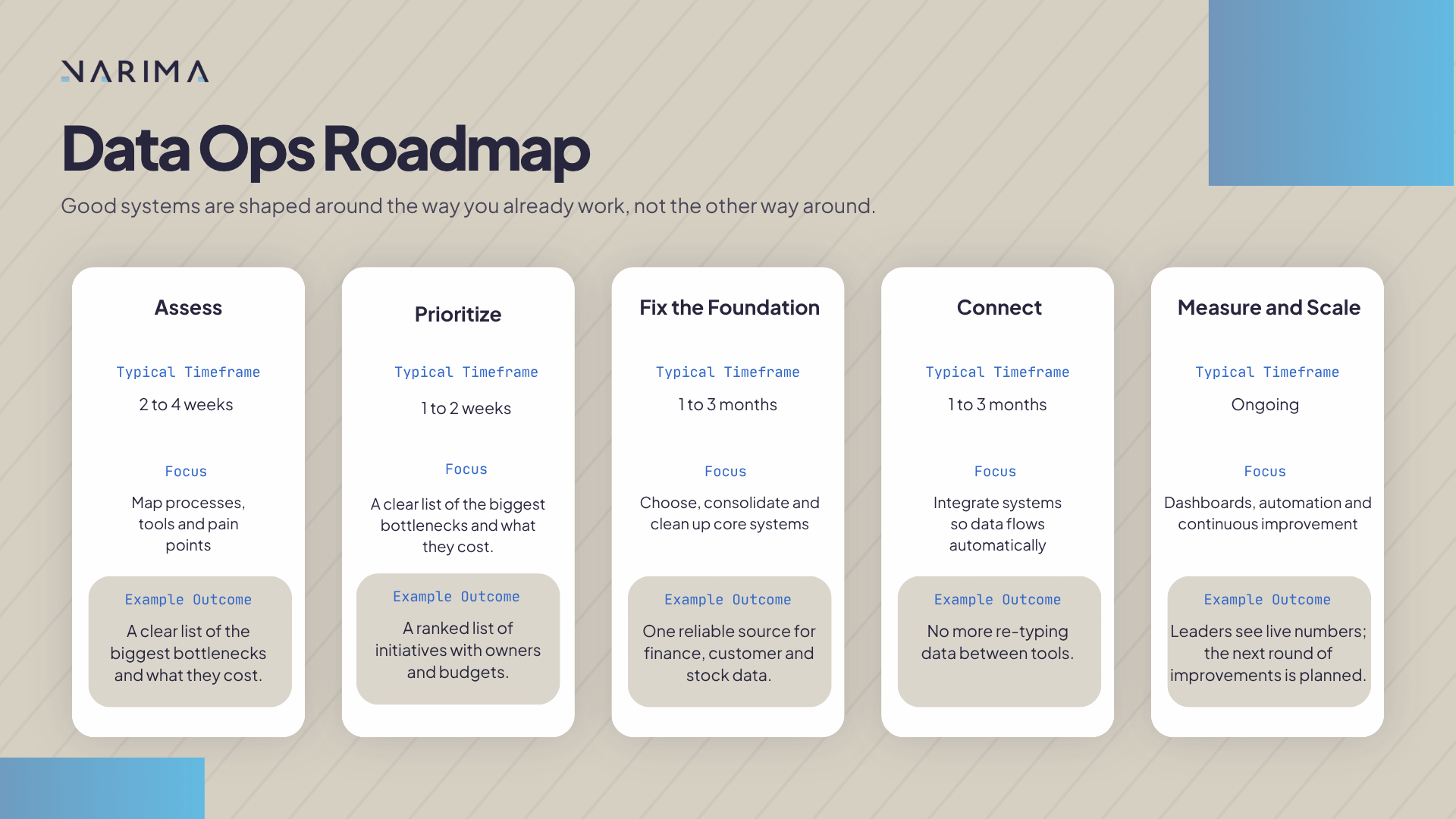
The quick answer: A digital transformation roadmap is a phased plan that links your business goals to specific technology changes, in the right order, with clear owners, budgets and measurable results. For most Indonesian SMEs, it moves through five phases: assess where you are, set priorities, fix your core systems, connect them, and then use the data to improve and scale.
Why digital transformation stalls in so many SMEs
Most stalled transformations share the same patterns:
Tools come before goals. Software gets bought because it's popular or a vendor pitched it well, not because it solves a defined problem.
Nothing is connected. Each new tool becomes another island of data, and the team fills the gaps by hand.
Nobody owns it. Digital projects sit on top of everyone's day job, so they drift.
The team isn't on board. People keep their old spreadsheets because the new system feels like extra work.
Success isn't measured. Without a clear before and after, it's impossible to tell whether the investment paid off.
A roadmap addresses all five by deciding the why, the order and the owner before money is spent.
What a digital roadmap is (and isn't)
A good digital roadmap is a short, practical plan, usually a few pages, that answers four questions:
Which business problems are we solving first, and why?
Which systems and processes need to change, and in what order?
Who owns each part, and what will it cost?
How will we know it's working?
It is not a shopping list of apps, and it's not a 100-page report that sits in a drawer. If your team can't use it to decide what to do next month, it isn't a roadmap yet. For a worked example, see what a digital roadmap actually looks like for a growing business.
What's different about digital transformation in Indonesia
Global roadmap templates often miss the realities of running a business here. A roadmap for an Indonesian company should account for:
WhatsApp-first customers. Many customers expect to order, ask and confirm through WhatsApp. Your roadmap should plan how those conversations feed into your order and customer records, not sit outside them.
Marketplaces and local payments. If you sell through Tokopedia, Shopee or your own store, and accept QRIS, bank transfers or local payment gateways, stock and payments need to sync across all of them.
Local business software. Many companies run on Indonesian platforms like Accurate or Jurnal. Your roadmap should build around the systems your finance team already knows, not force a switch without a strong reason.
Tax administration. With Coretax now handling tax administration, it pays to make sure your invoicing and accounting processes produce clean, consistent data.
Personal data protection. Indonesia's Personal Data Protection Law (UU PDP) makes how you store and share customer data a business responsibility, so data protection should be built into the plan from the start.
The roadmap: five phases
Timeframes vary with the size of your company and how many systems are involved. The order matters more than the speed.
Phase 1: Assess where you really are
Walk through your key processes from start to finish: how an order becomes cash, how a new client is onboarded, how a monthly report gets made. For each one, note which tools are used, where data is re-typed, and where work waits on someone.
Then put a rough cost on each bottleneck. Hours lost per week, errors per month, customers waiting. This turns "we should go digital" into a business case.
Phase 2: Set goals and choose what goes first
Turn your pain points into measurable goals. Good examples look like this:
Cut month-end closing from seven days to three.
Reply to every customer inquiry within one working hour.
Stop overselling across online channels.
Then rank initiatives by impact and effort. Start with one or two that are high-impact and realistic, so the team sees results early and trusts the rest of the plan.
Phase 3: Fix the foundation
Before adding anything new, make sure your core systems for finance, customers and operations are the right ones, and that the data inside them is clean. This is often where you remove tools, not add them. Two overlapping CRMs or three versions of the customer list will undermine everything that follows.
This is also the moment to set basic rules for data access and protection.
Phase 4: Connect your systems
Once the core systems are in place, connect them so an order, an invoice and a stock update flow automatically from one to the next. This is where most of the time savings usually come from. Our guide to system integration vs. standalone tools explains the options, from built-in connectors to custom integration.
Phase 5: Measure, improve and scale
With connected data, leaders can finally see what's happening in real time. Build simple dashboards around the goals you set in Phase 2, and review them regularly. Our guide to data visualization in business shows where to start.
Only then is it worth layering on advanced tools like AI-powered forecasting or process automation. They work far better on clean, connected data than on a pile of spreadsheets.
Throughout: bring your team along
Every phase involves people. Involve the staff who actually do the work when mapping processes, explain how each change makes their day easier, and give them proper training before a system goes live. A roadmap your team believes in moves much faster than one handed down to them.
Common mistakes to avoid
Copying another company's roadmap. Your bottlenecks, systems and team are unique. A competitor's plan solves their problems, not yours.
Trying to do everything at once. Big-bang changes overwhelm teams and budgets. Phase the work.
Skipping the foundation. Automating or adding AI on top of messy data just produces wrong answers faster.
Treating it as an IT project. Digital transformation changes how the business runs. Leadership needs to own the goals, not just approve the budget.
Do you need a digital roadmap consultant?
You can build a roadmap internally if someone on your team has the time, a cross-department view and experience with business systems. Many mid-sized companies find that combination hard to come by.
It's usually worth getting outside help when:
You've already invested in tools that haven't delivered the results you expected.
Departments disagree on priorities, and you need a neutral view.
No one internally has led a systems or integration project before.
You're planning a significant investment and want a clear business case first.
What to look for in a digital roadmap consultant in Indonesia:
Business-first thinking. They should ask about your goals and processes before talking about technology.
Vendor neutrality. Be cautious of advice that always leads to one software product.
Local knowledge. Familiarity with Indonesian business systems, payment methods and regulations saves time and mistakes.
An actionable output. You should receive a plan your team can execute, with priorities, owners and budgets, not just a presentation.
The ability to help you deliver. A partner who can also build or integrate what's in the plan, or hand it over cleanly, reduces the gap between strategy and results.
Frequently asked questions
How long does it take to create a digital roadmap?
For a mid-sized company, the assessment and planning work typically takes a few weeks, depending on how many teams and systems are involved. Delivering the roadmap is a longer process, usually phased over many months.
How much does digital transformation cost for an Indonesian SME?
It varies widely with your starting point and goals. That's exactly why a roadmap comes first: it breaks the investment into phases, so you can fund the highest-impact steps first and judge results before committing more.
Do we need to replace our current systems?
Not necessarily. Many roadmaps keep the core systems a company already uses and focus on cleaning up the data and connecting them. Replacement makes sense only when a system is truly holding the business back.
Where does AI fit in?
AI can add real value in forecasting, customer service and automation, but it depends on clean, connected data. In most roadmaps, it belongs in a later phase, after the foundation is solid.
What's the difference between a digital roadmap and an IT strategy?
An IT strategy usually focuses on technology infrastructure. A digital roadmap starts from business goals and covers processes, people and systems together, with technology as the means rather than the goal.
Start with a clear plan, not another tool
Digital transformation doesn't have to mean a massive overhaul. It means knowing which problems to solve first, fixing the foundation and connecting what you already have, one phase at a time.
If you'd like a clear picture of where to start, Narima can help you assess your current processes and systems and turn them into a practical, phased digital roadmap built for how your business actually works. Book a free roadmap consultation to get started.